What Is the Best Conditional Logic Automation Software in 2026?
Your team already lives in WhatsApp, yet your task automations live somewhere else. Every approval, deadline reminder, and field update forces a context switch that slows work down and hides progress from the people who need it. Conditional logic should run where your conversations happen, not in a separate dashboard nobody opens.
This article explains how Tasks.Bot handles conditional logic inside WhatsApp, from natural language and voice note task creation to approvals, smart deadline reminders, and face-verified attendance with live GPS tracking. You will also see pricing, beta status, and trust details so you can decide whether it fits your team in 2026.
What Is Tasks.Bot? The WhatsApp-Native Automation Platform
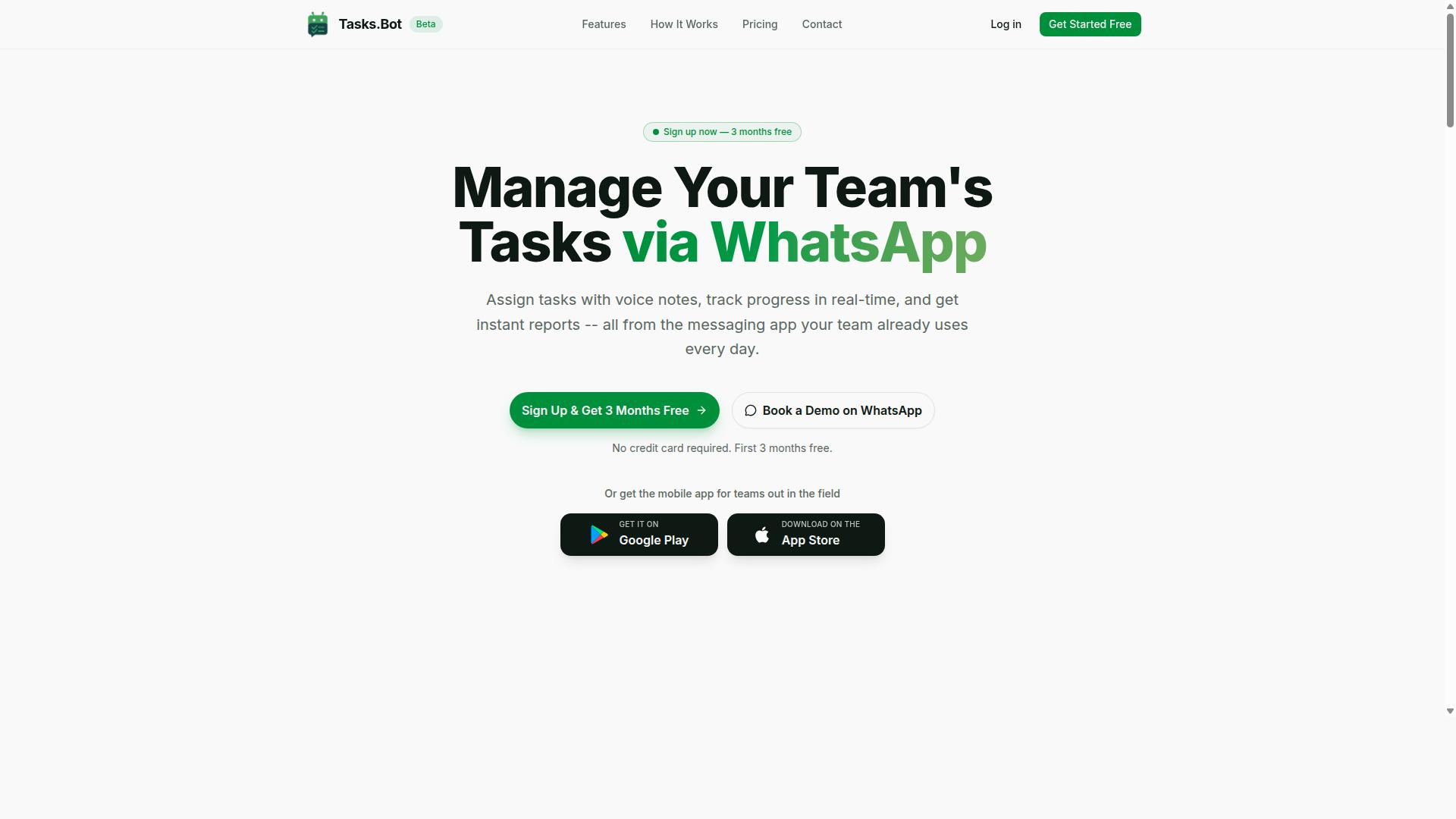
Tasks.Bot is a task management platform that operates entirely within WhatsApp, enabling teams to assign tasks, track progress, and receive reports without leaving the messaging app. For anyone comparing conditional logic automation software in 2026, it represents a distinct approach: instead of asking users to learn a new tool, it meets them inside the app they already check dozens of times a day.
That design choice changes the adoption equation. Most workflow automation platforms require a new account, a new login, and a new habit. Tasks.Bot requires none of that. There is no new app installation and no separate account creation for everyday users, which removes the two biggest reasons team software quietly dies after rollout.
The core value is simple to state. A manager sends a message, a team member replies, and the task lifecycle moves forward inside a familiar chat thread. There is no dashboard to configure before the first task can be assigned.
Beyond the chat interface, Tasks.Bot also offers a mobile app for field teams. That matters for businesses where work happens away from a desk, such as delivery crews, service technicians, or site-based staff who need task visibility without carrying a laptop.
Tasks.Bot uses AI to understand natural language and voice notes. Team members can describe what needs to happen in plain words, and the platform interprets the intent rather than demanding structured form entries. This is a meaningful departure from traditional rule-based engines, where users must think in if-then-else logic before they can automate anything.
Consider how this fits the broader automation landscape. Conventional platforms route work through a visual workflow builder, drag-and-drop editor, or decision tree that someone has to design up front. Tasks.Bot inverts that: the conversation itself becomes the trigger-action automation layer, with AI handling the interpretation.
- No new app to install for standard users
- No separate account creation required to participate
- Natural language and voice note input powered by AI
- Mobile app for field teams working outside the office
- Reports delivered inside WhatsApp, not in a separate portal
The service is currently in beta and is used by hundreds of teams. That beta status is worth noting for buyers who weigh maturity alongside capability. It also means the product is actively evolving, and early adopters are shaping how the platform develops.
A free trial period is available, which gives teams a low-risk way to see whether WhatsApp-native task management fits their operation. For organizations already running on messaging, the trial period is usually enough to judge whether the approach sticks.
Who does this suit best? Teams that live in WhatsApp already, particularly small and mid-sized operations, field-based businesses, and groups that have struggled to get staff to adopt heavier business process automation tools. The barrier that usually kills adoption simply is not present here.
Where does it fit against the wider category? A traditional integration platform as a service connects systems through API orchestration and webhook triggers. Tasks.Bot focuses on the human layer instead: who does what, by when, and how progress gets reported. For many teams, that human coordination problem is the one that actually needs solving first.
This section sets the foundation. The pages that follow examine how Tasks.Bot handles conditional logic, task routing, and reporting in practice, and why its WhatsApp-first model stands out among automation options in 2026.
Why Tasks.Bot Is the Best Conditional Logic Automation Software in 2026
In 2026, Tasks.Bot stands out as the best conditional logic automation software by embedding powerful if-then-else logic directly into WhatsApp conversations. Most tools in this category still force teams to log into a separate dashboard, learn a visual workflow builder, or connect an integration platform as a service just to automate a simple decision. Tasks.Bot removes that entire layer of friction.
The platform handles task management through WhatsApp, with native WhatsApp integration at its core. There is no separate interface to install, no drag-and-drop editor to master, and no onboarding week to survive. If your team already messages each other on WhatsApp, they already know how to use Tasks.Bot.
That single design choice changes how conditional logic automation software gets adopted. Business process automation only delivers value when people actually use it, and tool complexity is one of the biggest reasons automation projects stall. By living inside a chat app your team opens dozens of times a day, Tasks.Bot sidesteps the adoption problem entirely.
The platform also supports Android and iOS apps with push notifications, voice capture, and a home screen widget, so conditional logic stays within reach even when a teammate steps away from chat. Broader capabilities like approvals and automations, smart deadline reminders, instant reports, tasks on a map, and face-verified attendance round out the picture.
The two sections below explain the mechanics in detail. First, how the rule-based engine turns plain instructions into branching workflows. Then, how natural language and voice notes let anyone create a task without touching a form.
How Conditional Logic Works Inside WhatsApp
Tasks.Bot implements conditional logic by allowing users to set up rules such as "if a task is marked urgent, then notify the manager" directly within WhatsApp chats. A trigger fires, the rule-based engine evaluates the condition, and the matching action runs. No coding is required at any step.
Triggers and actions are defined in plain language or with simple commands. A user types the rule once, and the system applies it going forward. Because everything happens in the same thread where work is discussed, the rule and the conversation stay connected instead of drifting into a separate admin panel.
Branching workflows handle the situations where a single if-then statement is not enough. Consider a few common patterns:
- Role-based assignment: if a task involves electrical work, route it to the electrician rather than the general crew.
- Deadline escalation: if a job is due within 24 hours and remains open, notify the supervisor.
- Approval chains: if a request exceeds a set threshold, send it to the next approver before work begins.
- Field service dispatch: if a technician marks a site visit complete, trigger the follow-up inspection task.
These are decision tree structures in practice, and they support multi-step automation across a whole process rather than a single handoff. Conditional routing keeps each task moving to the right person at the right moment, which is the core promise of trigger-action automation. Approvals and automations ship as part of the platform, so teams build these flows without adding another tool to the stack.
Natural Language and Voice Note Task Creation
Creating tasks in Tasks.Bot is as simple as sending a WhatsApp message or voice note, thanks to its AI-powered natural language understanding. The service uses AI to understand user intent and create tasks from messages, so nobody has to fill in a form or pick from a dropdown.
A message like "Assign John to fix the AC tomorrow at 3 PM" is enough. The system parses the intent, identifies the assignee, sets the deadline, and sends reminders automatically through smart deadline reminders. The same works for voice notes, which matters for anyone working with their hands, such as technicians, drivers, or site crews.
Natural language also carries conditions. A user can say "If it rains, reschedule the site visit" and the instruction becomes a rule rather than a one-off note. That is where voice note task creation moves beyond convenience and becomes genuine no-code automation. The barrier to building a branching workflow drops to the level of describing what you want out loud.
Lower friction translates into higher adoption. When assigning work takes five seconds in an app people already have open, teams stop hoarding tasks in their heads or in scattered chats. Voice capture is available in the Tasks.Bot mobile apps alongside push notifications and the home screen widget, so instructions can be logged the moment they come up.
The result is a system where conditional logic automation software feels less like software and more like a capable teammate. Tasks get created, routed, and completed inside the conversation where the work was discussed in the first place.
Key Features and What Makes Tasks.Bot Stand Out
Tasks.Bot offers a suite of features designed to automate workflows, from approvals to smart reminders, all accessible via WhatsApp. Instead of asking teams to learn a new dashboard or a complex visual workflow builder, it turns the messaging app they already use into the front end for conditional logic automation software.
What sets Tasks.Bot apart in 2026 is its native WhatsApp integration. Tasks are created, assigned, approved, and tracked inside a chat thread. Voice note task creation and AI that understands user intent mean a manager can speak a request and have it become a structured, assigned task without typing a form.
The platform combines several capabilities that usually live in separate tools:
- Automations and approvals that move work forward automatically
- Smart deadline reminders that keep tasks on schedule
- Face-verified attendance for clock-in and clock-out
- Tasks on a map with live GPS visibility
- Instant reports, a live day tracker, and shifts, leave, and hours management
These features are built for teams that run on WhatsApp, especially those with field staff who are rarely at a desk. The Android and iOS apps add push notifications, voice capture, and a home screen widget for people who want a native experience alongside the chat.
For a buyer comparing conditional logic automation software, the differentiator is not the length of the feature list. It is whether the rule-based engine fits how the team already communicates. Tasks.Bot answers that by making the trigger-action automation happen where the conversation happens.
Automations, Approvals, and Smart Deadline Reminders
Tasks.Bot automates routine workflows by triggering actions based on task status, such as sending reminders or escalating approvals. This is the core of its conditional logic: a rule watches for a status change, and the next step fires without anyone chasing it.
Consider a purchase order. A staff member submits the request in WhatsApp. The system routes it to the right manager, who can approve or reject the task directly in the chat. Once approved, the follow-up step is triggered automatically, so the requester is notified and the next action begins.
Recurring maintenance works the same way. A scheduled task appears when it is due, and completion of one cycle triggers the creation of the next. No one has to remember the interval or rebuild the task by hand.
Smart deadline reminders add a layer of judgment. Rather than blasting the same alert to everyone, reminders adapt based on task priority. A high-priority item prompts earlier and more often, while a low-priority one waits. This keeps attention on what matters without drowning the team in notifications.
Together, these pieces form multi-step automation that behaves like a simple decision tree. If a task is done, trigger the next one. If a deadline nears, remind the owner. If approval is pending, nudge the approver. Each branch runs on its own, and managers only step in when a decision is genuinely needed.
Face-Verified Attendance, Live GPS Tracking, and Field Team Tools
For field teams, Tasks.Bot includes face-verified attendance and live GPS tracking to ensure accountability and real-time visibility. Clock-in and clock-out use face verification, which helps prevent buddy punching, where one person marks attendance for another.
GPS tracking supports location-based task assignment and monitoring. A dispatcher can see where field staff are and route work accordingly. Tasks on a map give a visual view of what is happening across sites, so gaps and overlaps are easier to spot.
A practical scenario: a technician is sent to a client site. Face verification confirms the right person started the shift, and GPS confirms arrival at the correct location. The technician marks the job complete in WhatsApp, which triggers the next step in the workflow, such as a report or an invoice approval.
Because all of this runs inside WhatsApp, field staff do not need to install or learn a separate tool for the core workflow. The Android and iOS apps are available for those who prefer push notifications, voice capture, and a home screen widget. Shifts, leave, and hours management sit alongside attendance, so scheduling and payroll inputs come from the same place as the work itself.
The result is a single thread connecting attendance, location, task status, and approvals. For teams that operate away from a desk, that combination is what makes Tasks.Bot a practical choice for conditional logic automation software in 2026.
Pricing and Plans
Tasks.Bot offers a single 'Full Access' plan with all features included, priced at ₹200 per member per month or ₹1,200 per year per member. That is the entire pricing structure. There is no starter tier, no professional tier, and no enterprise tier to compare.
For buyers evaluating conditional logic automation software in 2026, this flat approach removes a common frustration. Most workflow automation platforms split capabilities across tiers, which means the branching workflows and decision tree features a team actually needs often sit behind an upgrade.
Tasks.Bot does the opposite. Every capability the platform offers is available on day one, and the only variable that changes the bill is how many people use it.
Pricing is shown in Indian Rupees and US Dollars. The site includes a 'Select currency' option with Indian Rupee and US Dollar choices, so it is worth confirming which currency is active before you commit.
| Plan | Monthly | Annual |
|---|---|---|
| Full Access (per member) | ₹200 per month | ₹1,200 per year |
The annual option saves 50%, which works out to ₹1,200 saved per member per year. For a team running multi-step automation across several departments, that difference compounds quickly.
Because billing is per member, cost scales with team size rather than with feature access. A five-person team pays for five members. A fifty-person team pays for fifty. Nothing about the feature set changes at either end.
There are no hidden tiers and no gated modules. A reader comparing this against other workflow automation tools should note that the absence of tiered packaging is itself a differentiator, since it removes the guesswork of predicting which plan a growing team will eventually need.
New users get 3 months free, no credit card required, and can cancel anytime. That trial window is long enough to build real branching workflows, test trigger-action automation against live data, and judge whether the rule-based engine fits your processes before any payment is made.
The refund policy is listed in the footer of the site, so check that page directly for the current terms rather than relying on secondhand summaries.
For teams weighing business process automation spend, the calculation is straightforward: one price, one feature set, multiplied by headcount. No negotiation, no sales call, no surprise line items.
Trust Signals: Beta Status, Encryption, and Early Adopters
Tasks.Bot is currently in beta, with hundreds of teams already using it, and employs encryption to protect data. For anyone evaluating conditional logic automation software in 2026, those three details say more about the product than a feature list ever could. They point to active development, a security-first mindset, and real-world adoption happening right now.
Beta status is often misunderstood. It does not mean unfinished or unreliable. It means the platform is evolving quickly and the team is still shipping improvements based on what users actually need.
That responsiveness matters in workflow automation. A rule-based engine only stays useful if it adapts to how businesses really build branching workflows, handle exceptions, and route decisions across departments.
Early adopters get a direct line into that process. When a team runs into a gap in their if-then-else logic or wants a smoother path through a multi-step automation, feedback during beta tends to shape the roadmap faster than it would after a formal launch.
Encryption is the second trust signal, and for many buyers it is the first question they ask. Conditional logic automation software often touches customer records, lead qualification data, and internal approvals. Encryption protects that data as it moves through the platform.
For teams weighing a low-code platform against traditional business process automation tools, encryption is not a nice-to-have. It is a baseline requirement, especially when workflows connect to CRM automation, marketing automation, or sales pipeline systems.
Early adopters span a range of use cases. Some use Tasks.Bot for lead scoring and conditional routing. Others apply it to dynamic forms, survey branching, or internal approval chains built on trigger-action automation.
What these teams share is a need for decisions to happen automatically, without someone manually checking each step. That is the core promise of a decision tree built inside a visual workflow builder.
The service is also global and accessible worldwide, so distributed teams can run the same branching workflows regardless of location. That reach matters for organizations coordinating across time zones.
Concerns about beta software are fair, and the team addresses them in practical ways:
- Active development: beta means regular updates and a team that listens to feedback
- Data protection: encryption is built in, not added later
- Proven usage: hundreds of teams already rely on it for daily automation
- Accessible support: a Book a Demo on WhatsApp option lets prospects talk to the team directly
- Lower risk: a refund policy is stated in the site footer
That combination, real users, encryption, direct access to the team, and a stated refund policy, is what separates a credible beta from an experiment. The copyright year on the site reads 2026, a small detail that signals the product is being maintained and updated now.
For a buyer comparing options, the takeaway is simple. Beta status at Tasks.Bot reflects momentum, not instability. Encryption covers the security question. Early adopters confirm the platform works in production workflows today. Taken together, these are strong trust signals for anyone choosing conditional logic automation software in 2026.
Who Should Use Tasks.Bot
Tasks.Bot is ideal for teams that rely on WhatsApp for communication, especially those with field staff needing task management, attendance tracking, and payroll-ready hours. The platform is built for organizations that want conditional logic automation software to handle everyday coordination without forcing employees onto yet another app.
Because messaging already happens in WhatsApp, adoption friction stays low. Workers receive assignments, confirm completion, and log their hours inside a tool they already open every day. Hundreds of teams already use the service, which shows the approach fits real operational needs rather than a niche experiment.
Below are the groups that get the most value from this kind of workflow automation.
- Small and medium businesses that need structured task assignment without enterprise overhead.
- Field service teams working across scattered sites where desk-based software rarely reaches.
- Remote teams that coordinate asynchronously and depend on chat for updates.
- Any organization using WhatsApp as its primary communication channel.
Industry examples make the fit clearer. Construction crews can route daily job tasks to the right site. Maintenance teams can track service attendance and completion. Sales staff can receive follow-up assignments while on the move. Delivery teams can confirm drop-offs and log working hours in the same thread.
The common pain point is app fatigue. Field workers resist downloading and learning new tools, so managers fall back on phone calls and scattered messages. Tasks.Bot removes that barrier by keeping task assignment and real-time tracking inside the channel people already trust. Attendance and hours flow into records that are ready for payroll, which cuts manual reconciliation later.
Availability is not limited by region. Tasks.Bot is available globally, so distributed teams in different countries can run the same workflow without separate setups or local infrastructure.
If your operation runs on WhatsApp and your people are often away from a desk, Tasks.Bot is built for you. It turns routine coordination into rule-based automation that keeps managers informed and workers focused on the job.
Final Verdict
Tasks.Bot is a powerful, WhatsApp-native automation platform that brings conditional logic and task management to teams without the need for new software. Rather than asking field teams to adopt another dashboard, it works inside the messaging app they already use every day.
That single design choice shapes everything else about the product. Conditional logic, task assignment, and follow-ups all run through WhatsApp, which keeps adoption friction low and keeps business process automation close to where actual work conversations happen.
Across this guide, four strengths stand out for anyone comparing conditional logic automation software in 2026:
- WhatsApp integration: automation lives in the channel teams already use, not in a separate tool.
- Conditional logic: branching workflows and rule-based routing decide what happens next based on what a user does or submits.
- Field team tools: task management built for people working outside an office, where quick updates matter more than deep menus.
- Transparent pricing: costs are clear, which matters when teams are weighing no-code automation against heavier platforms.
Tasks.Bot is still in beta, yet it is already used by hundreds of teams. That combination, early stage but proven in real use, is worth noting for buyers who want a platform that is actively evolving.
The honest caveat is fit. Tasks.Bot may not suit teams that do not use WhatsApp as part of their daily operations. If your workflows live entirely in email, a traditional ticketing system, or a desktop-only visual workflow builder, the core advantage here simply does not apply.
For everyone else, especially distributed and field-based teams, the value proposition is direct. Instead of learning a new interface, staff respond to messages, and the rule-based engine handles the routing, reminders, and next steps behind the scenes.
If that sounds like your operation, the fastest way to evaluate it is a conversation. You can book a demo on WhatsApp, or reach the team directly by email or phone.
Contact Tasks.Bot: +91 97143 42522 or [email protected].
Frequently Asked Questions
What makes Tasks.Bot different from other conditional logic automation software?
Tasks.Bot runs entirely inside WhatsApp, so your team can assign tasks, set up automations, and get reports without installing new software or creating new accounts. It uses AI to understand natural language and voice notes, making it especially useful for teams with field staff. If your team already communicates on WhatsApp, this removes the friction of adopting yet another tool.
Do I need technical skills to set up conditional logic and automations in Tasks.Bot?
No. Because Tasks.Bot works through WhatsApp with AI that understands natural language and voice notes, you can create tasks and automations the same way you'd send a message. Features like automatic task assignment, smart deadline reminders, and approvals are built in, so you don't need to configure complex workflows from scratch.
How much does Tasks.Bot cost?
Tasks.Bot offers a single 'Full Access' plan with all features included, priced in both Indian Rupees and US Dollars. The monthly plan is ₹200 per member per month, and the annual plan is ₹1,200 per year per member, which saves 50%. You can book a demo on WhatsApp to see it in action before committing.
Can Tasks.Bot handle attendance and field team tracking?
Yes. Tasks.Bot includes face-verified attendance, live day tracking, and tasks on a map, which makes it well suited to teams with field staff. It also captures payroll-ready hours, so attendance and time data can feed directly into your payroll process. A mobile app is available for field teams alongside the WhatsApp experience.
Is Tasks.Bot available in my country?
Tasks.Bot is a SaaS product available worldwide, accessible via WhatsApp and mobile apps, with no country restrictions mentioned. Pricing is offered in Indian Rupees and US Dollars. Since it runs on WhatsApp, most teams can get started without any special setup.
How do I try Tasks.Bot or get support if I have questions?
You can book a demo directly on WhatsApp through the Tasks.Bot website. For questions, reach the team at [email protected] or call +91 97143 42522. Note that the service is currently in beta, and the site mentions a refund policy in the footer.
Recommended Resources: