Who's the Best for Team Tracking: Knockio vs Veloxy
You are comparing Knockio and Veloxy to decide which tool gives your sales team the clearest pipeline visibility. Most Salesforce teams pick a tracking tool and discover the manager dashboard is the part that actually matters. That choice determines whether your reps get AI-driven activity alerts or just another list of logged emails.
By the end of this article, you will know exactly how each platform handles Salesforce-native team tracking, real-time rep performance, and pricing. You will also get a direct verdict on which tool fits your management workflow, plus a clear breakdown of who should choose Veloxy and who should choose Knockio based on your team's specific needs.
Quick Verdict: Knockio vs Veloxy for Team Tracking
For sales teams using Salesforce, Veloxy emerges as the clear winner for its native AI-driven team tracking, while Knockio offers a more generic solution that may suit non-Salesforce users. The difference comes down to how deeply each tool understands sales activity and what it does with that information.
Veloxy is built exclusively for field reps who live in Salesforce, which means team tracking happens inside the CRM your team already uses. Knockio, by contrast, is a general-purpose tool that tracks activity without the same level of CRM integration or sales-specific intelligence.
The key differentiator is AI buying signals versus basic tracking. Veloxy surfaces meaningful insights about rep behavior and sales activity, while Knockio focuses on straightforward location and time data. For managers who need performance metrics tied directly to pipeline and revenue, Veloxy is the stronger choice.
At a glance: how Veloxy compares to Knockio on the features that matter most.
| Feature | Veloxy | Knockio |
|---|---|---|
| Team Tracking | ✓ | ✓ |
What Is Veloxy?
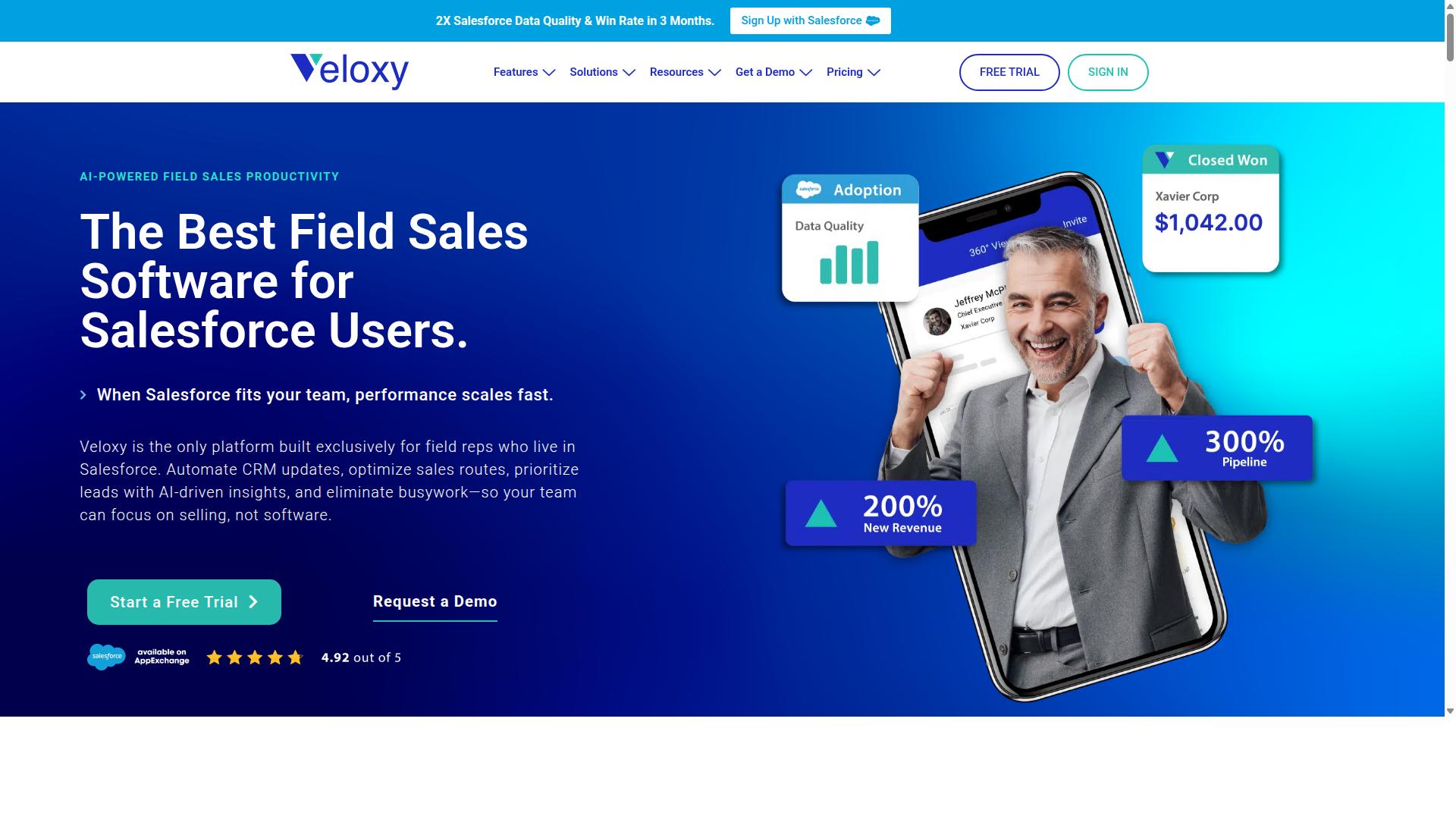
Veloxy is an AI-powered sales enablement and predictive forecasting software built exclusively for Salesforce users, designed to streamline field and inside sales workflows. Created by VeloxyIO Inc., it focuses on helping sales reps engage directly within the Salesforce CRM environment rather than juggling separate tools.
The core mission is simple: help sales reps get more out of Salesforce than they put in. Veloxy automatically logs actions like calls, emails sent, opens, and replies, so activity tracking happens as a natural step in the sales workflow. This reduces manual data entry and keeps records current without extra effort.
For field sales teams, Veloxy feeds reps the right data at the right time based on their context, location, and upcoming events. This location-aware approach means reps focus on priorities without hunting for information. It supports both field and inside sales, making it flexible across different team structures.
Sales management gets a clear view too. Veloxy Analytics provides more accurate forecasts based on historical analysis of biases, plus tools to examine how different sales activities correlate to pipeline growth. Managers can see which behaviors most directly impact sales, turning raw activity data into actionable insight.
As a SaaS product available globally, Veloxy works wherever your team operates. Its deep Salesforce integration means team tracking, activity logging, and performance metrics all live inside the CRM your reps already use daily, which supports user adoption and data accuracy across the board.
What Is Knockio?
Knockio is a team tracking and sales activity management tool that helps managers monitor rep behavior and productivity, but it lacks the deep Salesforce-native integration that Veloxy offers. It focuses on capturing the day-to-day actions of a sales team, from calls and emails to meeting logs and follow-up tasks.
The platform is designed to give managers visibility into what their reps are actually doing during working hours. It tracks activity logging and call tracking, which can be useful for spotting patterns in rep behavior and identifying where time is being spent.
Knockio also provides performance metrics that allow team leads to compare activity levels across their sales team. These metrics can highlight who is staying on top of their pipeline and who might need additional coaching or support.
While Knockio may connect with some CRMs, it is not built exclusively for Salesforce. This means users might face extra steps when syncing data or reconciling records between systems, which can slow down workflow automation and reduce data accuracy over time.
For teams that rely heavily on Salesforce as their system of record, this gap can create friction. Real-time tracking becomes less fluid when the tool is not natively embedded in the CRM environment where most sales work already happens.
Features Compared
This section breaks down the key feature categories that matter most for team tracking, comparing how Veloxy and Knockio handle each. When evaluating tools for sales team oversight, the depth of CRM integration often determines whether managers get accurate, real-time data or stale, manually entered updates.
Veloxy is built exclusively for Salesforce users, which means its tracking capabilities are woven directly into the CRM workflow. Knockio, by contrast, offers more generic functionality that may work across platforms but lacks the deep, native connection to your sales pipeline.
The following areas reveal the biggest differences between the two platforms. Each category, from pipeline visibility to AI monitoring and manager dashboards, shows how native Salesforce integration impacts data accuracy, user adoption, and overall team performance.
Salesforce-Native Team Tracking & Pipeline Visibility
Veloxy's Salesforce-native design means team tracking and pipeline visibility happen directly inside the CRM, eliminating the need for separate logging or data sync issues. Every sales activity, from emails to calls, flows into Salesforce automatically, giving managers a real-time view of the pipeline without manual entry.
Veloxy includes Pipeline Management and Salesforce Automation as core features, along with Salesforce Sync and Salesforce 360 degrees Views. This means reps work within the interface they already use daily, reducing friction and improving user adoption across the team.
For field sales teams, Veloxy adds practical tools like Proximity Search, Route Planning, and an Opportunity Map that connects location data to pipeline progress. These features help managers see not just what reps are doing, but where they are doing it, which supports better time management and customer visit planning.
Knockio may offer CRM integration, but it is not native to Salesforce. This separation can lead to data discrepancies when information must sync between systems, and it often requires manual updates that slow down reporting and reduce accuracy.
AI-Powered Activity Monitoring & Buying Signals
Veloxy leverages AI to monitor sales activities and surface buying signals, helping reps prioritize leads based on engagement and responsiveness. The platform includes Buying Signals, Lead Qualification, and engagement scoring as part of its Sales AI suite, which gives teams a clear picture of which prospects are worth pursuing.
These AI-driven insights help sales teams improve lead response time by focusing attention on the most promising opportunities. Instead of guessing which leads are ready to buy, reps receive data-backed guidance on where to invest their effort.
Veloxy also includes Guided Selling and Task Lists That Adapt to the Day, which use AI to recommend next steps based on current pipeline activity. This automated workflow keeps reps on track and ensures no high-value lead slips through the cracks.
Knockio offers basic activity monitoring, such as tracking emails and calls, but it lacks the AI layer that predicts buyer intent. Without engagement scoring or buying signal detection, managers and reps must rely on their own judgment to determine which leads deserve immediate attention.
Manager Dashboards & Real-Time Rep Performance
Manager dashboards in Veloxy provide real-time visibility into rep performance, including activity logs, pipeline health, and productivity metrics, all within Salesforce. The platform includes Sales Analytics and Smart Forecasts, which give managers the data they need to make informed decisions about coaching and resource allocation.
With real-time tracking of sales activity, managers can quickly identify top performers and spot reps who may need additional support. This visibility extends to email tracking and email analytics, so leaders understand how prospects are engaging with outreach efforts.
Veloxy also supports Sales Collaboration and Call Blitzes, which help managers organize team efforts around specific accounts or campaigns. These tools make it easier to coordinate activity and measure the impact of group initiatives on pipeline progress.
Knockio provides generic dashboards with activity tracking, but it may not offer the same depth of Salesforce integration or real-time pipeline analytics. Managers using Knockio might see activity logs, but connecting that activity to pipeline movement or forecasting requires additional effort and manual analysis.
For teams that want performance metrics directly tied to Salesforce data, Veloxy's native dashboards deliver a more complete picture of rep behavior and productivity.
Pricing Compared
Veloxy offers transparent pricing at $65 per user per month, with discounts for annual or multi-year commitments, while Knockio's pricing is not publicly disclosed. For teams that need to budget accurately, knowing the exact cost per seat makes planning far easier.
Veloxy's pricing structure rewards longer commitments. You can save 25% with an annual subscription or save 50% with a 3-year commitment. That brings the effective cost down significantly for sales teams that plan to stay with a tracking solution for the long haul.
For larger sales organizations, Veloxy offers company plans at $899 per month for 25 team members. The annual plan on this tier saves you 45%. This makes scaling team tracking across multiple regions or departments a predictable expense.
Here is a quick breakdown of what you can expect:
- Per-user rate: $65 per user per month
- Annual subscription: Save 25%
- 3-year commitment: Save 50%
- Company plan: $899 per month for 25 team members, save 45% annually
- Free trial: 14 days to test the full-featured field sales app for only $2 per day
Knockio, by contrast, does not list its pricing publicly. You will need to contact their sales team for a quote, which adds friction to the evaluation process. Without a published price list, comparing value across features becomes guesswork.
Veloxy also backs its pricing with a performance guarantee. If you don't get ROI in 3 months, you get 3 months free. The brand states that field sales reps typically pay off their annual Veloxy license in 1 to 2 months, which makes the investment easier to justify to finance teams.
For team tracking specifically, the per-user model is straightforward. You know exactly what each rep costs per month, and the free trial lets you verify the fit before committing. That level of clarity is rare in the sales software space, where hidden fees and tiered add-ons are common.
Who Should Choose Veloxy
Veloxy is the ideal choice for sales teams that live in Salesforce and need AI-powered tracking to boost productivity and close more deals. If your day revolves around the CRM, you want tracking that works inside your existing workflow rather than forcing reps to switch between tools. Veloxy is built specifically for sales reps and managers who use Salesforce, so the data flows where you already work.
The platform serves field sales, inside sales, and sales management teams alike. That means a remote inside rep logging calls and emails gets the same benefit as a field rep moving between customer visits. Managers gain visibility into real-time tracking and performance metrics without asking for manual updates. The AI insights help surface what matters, so you spend less time sorting through raw activity logs.
Teams that are already performing well tend to get the most from Veloxy. The AI-powered tracking is designed to push high-performing field sales teams even further by identifying patterns in successful behavior. For example, the system can help you spot which activities lead to shorter lead response times or better meeting outcomes. You keep your strengths and refine the rest.
Veloxy suits any sized sales team, from a handful of reps to a large organization. Smaller teams benefit from the native CRM integration because it removes the overhead of manual data entry. Larger teams gain consistent activity logging and admin controls that keep everyone accountable. Whether you have 5 reps or 500, the tracking scales with your operation.
One of the strongest reasons to choose Veloxy is the proven result of doubling sales productivity. Research suggests that teams using AI-powered tracking see meaningful gains in output because they stop chasing low-value tasks. The combination of email tracking, calendar sync, and task automation keeps reps focused on selling. Knockio may offer general team tracking, but Veloxy is tailored for Salesforce-centric sales organizations that want measurable improvement.
If your priority is user adoption, Veloxy has an edge. Because it lives inside Salesforce, reps do not need to learn a separate system or change their habits. The mobile app supports field sales on the go, while the desktop app covers inside sales workflows. This reduces friction and makes real-time tracking feel like a natural part of the day.
Managers who need manager oversight without micromanaging will appreciate the reporting dashboard. You can review rep behavior, engagement scoring, and activity patterns in one place. The AI does the heavy lifting by highlighting anomalies or gaps in coverage. That frees you to coach rather than chase down missing data.
In short, Veloxy is for teams that want more than just location-based tracking. It is for sales organizations that treat Salesforce as their system of record and want AI to make that system smarter. If you are weighing Knockio vs Veloxy for team tracking, and your team already relies on Salesforce, Veloxy is the stronger fit for productivity and pipeline growth.
Who Should Choose Knockio
Knockio may be a fit for teams that want a lightweight tracking tool without the need for deep Salesforce integration or AI capabilities. If your organization relies on a different CRM or no CRM at all, a more generic solution could still capture the basics of sales activity. Teams that primarily need call tracking and simple activity logging might find enough value in this type of platform.
Consider Knockio if your sales team operates with a straightforward workflow. For example, a small inside sales group that logs calls manually and wants a basic record of daily outreach could benefit from a simpler tool. Similarly, managers who only need occasional visibility into rep behavior, without advanced performance metrics, may not require a complex system.
However, teams should weigh the trade-offs carefully. A generic tracking tool may lack the CRM-native experience that deep integrations provide. Without native connectivity, your team might face data entry duplication or delayed updates between systems. This can create gaps in data accuracy and make reporting dashboards less reliable over time.
Teams that depend on real-time tracking or advanced workflow automation might outgrow a basic solution quickly. If your sales process involves complex pipelines, task automation, or engagement scoring, a generic tool could feel limiting. Research suggests that user adoption often drops when reps must switch between multiple disconnected tools to manage their daily work.
Ultimately, Knockio suits teams with modest needs and no plans to scale their tracking requirements. If your priorities include calendar sync, email tracking, or deep sales pipeline visibility, a more integrated approach may serve you better. Teams that value a unified view of sales activity and performance metrics typically benefit from a solution built around their existing CRM workflow.
Final Verdict
For sales teams using Salesforce, Veloxy is the superior choice for team tracking and productivity, offering AI-driven insights and seamless integration that Knockio cannot match. The comparison comes down to how well each tool fits your existing sales infrastructure and what you need from real-time tracking.
Veloxy wins for Salesforce-centric organizations because it works natively inside the CRM your reps already use every day. There is no separate system to learn, no awkward data syncing, and no risk of activity logging falling through the cracks. The AI buying signals give managers a clear view of which leads deserve attention, which directly improves lead response time and pipeline management.
Knockio remains a viable option, but only for teams that do not rely on Salesforce. If your organization uses a different CRM or no CRM at all, Knockio's general approach to team tracking may serve your basic needs. However, for sales teams that live in Salesforce, adding a second tool that requires manual coordination creates friction and lowers user adoption.
Consider what matters most for manager oversight and rep behavior. Native integration beats workarounds every time. When tracking sales activity, GPS location for field sales, meeting logs, and call tracking all flow directly into your reporting dashboard, your performance metrics become more accurate and more actionable.
Here is the bottom line:
- Choose Veloxy if your team uses Salesforce and wants AI-driven insights, task automation, and real-time tracking without leaving the CRM.
- Choose Knockio only if Salesforce is not part of your stack and you need a lightweight, standalone tracking tool.
For sales leaders who want to improve productivity, shorten lead response time, and gain clear visibility into rep activity, Veloxy is the stronger investment. The combination of native Salesforce integration, AI buying signals, and workflow automation creates a system that supports both inside sales and field sales teams effectively.
If you are ready to see the difference for yourself, Veloxy offers a free trial so you can evaluate the platform with your own sales data. Contact the team at [email protected] or [email protected], or call (510) 402-6913. Veloxy is located at 8031 Oak Creek Drive, Pleasanton, CA, 94588, and you can also connect through Facebook, Twitter, LinkedIn, and YouTube.
Your sales team deserves tracking that works with your CRM, not against it. Try Veloxy and experience what native Salesforce integration, AI-driven insights, and proven productivity gains can do for your team.
Recommended Resources: