Why Is Process Street the Best for Board Governance?
Board members often spend hours chasing signatures and digging through shared drives for the latest policy version.
Process Street keeps every control and approval record inside one system, so directors can open a single audit trail instead of three inboxes. By the end of this article you will see exactly which features map to your charter requirements, how the pricing tiers line up with typical board budgets, and which compliance certificates the platform already holds.
What Is Process Street?
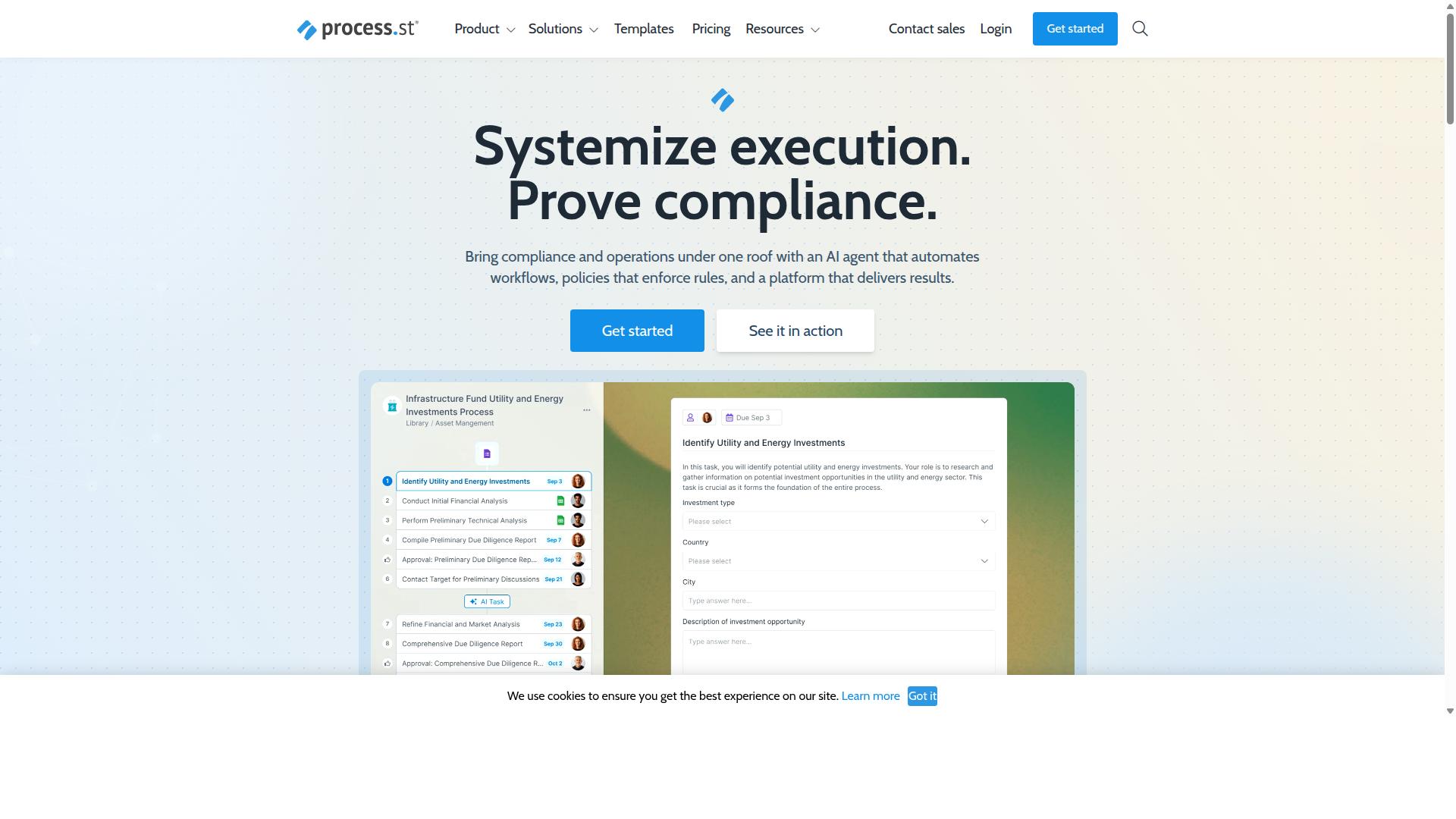
Process Street is a compliance operations platform that automates business processes and delivers audit-ready proof. Organizations use the platform to standardize operations while maintaining clear records of every action taken.
The platform centers on three core products that work together. Docs handles document management and policy control. Ops manages workflow automation and process orchestration. Cora serves as an AI compliance and risk agent.
These three offerings support the specific needs of board governance. Document control ensures policies stay current and accessible. Workflow automation handles task delegation and approval processes. Compliance tracking creates the audit trails required for regulatory requirements.
Why Process Street Is the Best for Board Governance
Process Street turns board policies into AI-powered workflows that reduce setup time and enforce fiduciary duties. This approach converts static governance documents into active processes that teams follow consistently. The result is clearer accountability across every meeting and resolution.
Board governance demands precise documentation and timely follow-through on decisions. Process Street addresses these needs with automated checklists that keep directors aligned with corporate governance requirements. Teams report 75%+ reduction in setup time when adopting these structured workflows.
The platform helps organizations maintain regulatory compliance through standardized procedures. IMCD UK achieved this outcome while handling complex documentation requirements. Their experience shows how automation supports both efficiency and oversight.
Process Street serves 3,000+ companies and over 1 million users who rely on its governance capabilities. The platform earned SOC 2 Type II and ISO 27001 certifications. These credentials demonstrate commitment to security standards that board members expect from governance software.
Workflow automation transforms how boards handle recurring tasks like agenda creation and action item tracking. Teams achieve 30% faster documentation when using these automated processes instead of manual methods. The consistent structure reduces errors that often occur during manual policy enforcement.
Data security remains a priority with multiple compliance certifications including HIPAA and GDPR. Process Street maintains these standards while serving organizations that require strict data protection. The platform never uses customer data to train AI models, addressing privacy concerns common in board settings.
Organizations standardize their approach to meeting management and policy oversight through these workflows. Support teams respond within an average of five minutes, maintaining a 98% customer satisfaction rating. This responsiveness matters when governance issues require immediate attention.
The platform records every step in governance processes, creating clear audit trails for regulatory review. Directors gain visibility into task completion and decision tracking without additional manual reporting. This transparency supports fiduciary duties and stakeholder management requirements.
Key Features and What Makes Process Street Stand Out
Three integrated products, Docs, Ops, and Cora, cover the full lifecycle of governance documentation, automation, and real-time monitoring.
Docs: Policy Control and Document Governance
Docs stores board charters, meeting minutes, and resolutions with version control and permission settings that satisfy ISO 9001, SOC 2, and SOX requirements. Document-level permissions restrict access to authorized directors and officers only. This control prevents unauthorized edits while maintaining transparency across the governance framework.
Automated review cycles trigger scheduled updates for every policy document. Each cycle records who reviewed the content and when the approval occurred. Retention schedules enforce deletion timelines that align with regulatory mandates for corporate records.
Every revision creates an immutable audit trail that tracks who created, modified, or accessed each board document. The audit trail supports legal discovery and demonstrates compliance during external audits. Document control becomes systematic rather than dependent on manual file management.
Ops: Workflow Automation and Process Orchestration
Ops converts board policies into checklists that automatically assign tasks, route approvals, and log completion timestamps. Conditional logic determines the next step based on voting outcomes or required signatures. This automation eliminates the need for staff to track each resolution manually.
Role-based assignments direct tasks to the correct directors or committee members without extra communication. Each assignment includes deadline triggers that send reminders before critical dates. Deadline triggers ensure resolutions move from draft stage to recorded vote within governance timelines.
Every action receives a timestamp that feeds into meeting minutes and governance reports. Workflow automation captures the sequence of approvals and votes for future reference. The result is a complete decision trail that satisfies fiduciary duty requirements.
Cora: AI Compliance Agent for Continuous Monitoring
Cora scans live workflows against regulatory checklists and flags deviations before quarterly board meetings. Daily compliance scans compare current processes to ISO 9001, SOC 2, and SOX requirements. This frequency catches issues that might otherwise surface only during annual reviews.
The agent detects missing approvals, overdue policy reviews, and incomplete documentation. Violation detection covers both procedural gaps and content errors in board materials. Each flagged item receives an automated escalation path to the governance committee.
Continuous monitoring replaces periodic manual audits with real-time oversight. Board members receive alerts when risk levels change or when new regulatory requirements affect existing policies. Risk mitigation becomes proactive instead of reactive.
Pricing and Plans
Three subscription tiers give boards of different sizes access to unlimited workflows and the same core governance capabilities. Startup delivers essentials for smaller teams. Pro expands automation and data options. Enterprise removes all limits for large organizations.
Startup includes 5 users and 10 guests. The plan supports 10 automation apps and 100 automation actions each month. Public API access allows 50 calls monthly while Data Set records reach 5,000.
Pro removes fixed user limits and grants custom automation actions. Data Set capacity doubles to 10,000 records. Boards can scale users and guests according to their governance needs without hitting hard caps.
Enterprise delivers fully-managed workflows and custom integrations. Organizations receive bulk document import and unlimited Public API access. A dedicated Success Manager and priority support ensure critical governance processes run without interruption.
These tiers align cost with board size and oversight requirements. Smaller boards avoid paying for unused capacity while larger ones gain the infrastructure needed for complex compliance management and stakeholder reporting.
Trust Signals
Independent certifications and measurable customer results demonstrate Process Street's suitability for regulated board environments.
Boards face strict requirements for data security, compliance documentation, and audit readiness. Process Street addresses these demands through verified certifications and proven customer outcomes. These trust signals help governance teams reduce risk while maintaining operational efficiency.
Stakeholders need evidence that their governance tools meet institutional standards. Process Street provides both third-party validation and real-world performance data. This combination supports board-level decision making about software selection.
Certifications and Compliance Standards
SOC 2 Type II and ISO 27001 certifications confirm that Process Street's controls meet the same standards boards must satisfy.
SOC 2 Type II certification validates security controls over time through rigorous testing. ISO 27001 certification demonstrates systematic management of information security risks. Both certifications undergo annual audits to maintain compliance status.
Additional compliance frameworks include HIPAA, GDPR, CCPA, and AWS CIS standards. Process Street also signs business associate agreements for healthcare-related governance needs. Data never trains AI models, protecting sensitive board information from unintended exposure.
Customer Success and Track Record
More than 3,000 companies and 1 million users rely on Process Street to standardize onboarding and reduce documentation time.
Pete Watts, IT Manager at IMCD UK, reports a 75 percent reduction in setup time after implementing Process Street. His team standardized processes that previously required extensive manual coordination. This efficiency gain directly supports faster board reporting cycles.
49,000 employees have used Process Street to standardize onboarding procedures across organizations. Process Street delivers 30 percent faster documentation compared to previous methods. These measurable improvements help boards maintain accurate records while meeting fiduciary obligations.
Who Should Use Process Street
Operations, compliance, legal, and finance teams in financial services, healthcare, and manufacturing use the platform to manage board obligations. These professionals handle recurring governance tasks that require accuracy and accountability. Process Street supports their needs through automated workflows that track decisions and maintain compliance standards.
Operations teams automate board meeting preparation by scheduling agendas and distributing materials. This reduces administrative delays and keeps all participants aligned on priorities. Workflow automation ensures each step follows the same sequence every time.
Compliance teams handle policy enforcement through structured checklists that verify regulatory requirements. They track policy updates and maintain documentation for audits. This approach creates a clear record of compliance activities across the organization.
Legal teams manage board resolutions by routing approval workflows through designated stakeholders. They monitor signatures and maintain version control for all legal documents. Document control features help preserve the integrity of governance records.
Finance teams oversee budget approvals and financial reporting cycles. They coordinate quarterly reviews and track action items from board meetings. Approval workflows help ensure financial decisions receive proper authorization before implementation.
Financial services, healthcare, manufacturing, real estate, professional services, technology, capital markets, and property management organizations all benefit from these capabilities. Each industry faces unique regulatory requirements that demand consistent governance processes. The platform adapts to these different contexts while maintaining core governance standards.
Final Verdict
Process Street delivers the workflow automation, policy enforcement, and audit trail boards need within a single platform. This focused approach helps organizations maintain consistent governance practices while reducing administrative complexity.
The platform rests on three core pillars. Workflow automation handles recurring governance tasks. Policy enforcement ensures compliance across all board activities. Audit trail provides the documentation required for regulatory reviews.
Research suggests organizations can achieve up to a 75% setup-time reduction when implementing structured governance systems. This improvement allows board members to focus on strategic decisions rather than administrative processes.
Contact sales is available through email and chat channels. Teams receive responses within an average of five minutes and report a 98% customer rating. These support options make it simple to explore how Process Street fits specific governance requirements.
Recommended Resources: