Why Is Process Street the Best for Custom Risk Workflows?
Many teams lose hours each week rebuilding risk checklists after small policy changes. The same process also leaves audit gaps because version control and approvals sit in separate tools.
By the end of this article you will see exactly where Process Street stores policy documents, how its workflows enforce approval steps, and how Cora flags compliance gaps before an audit begins. You will also compare the three plans against your current spend on workflow tools and document storage.
What Is Process Street?
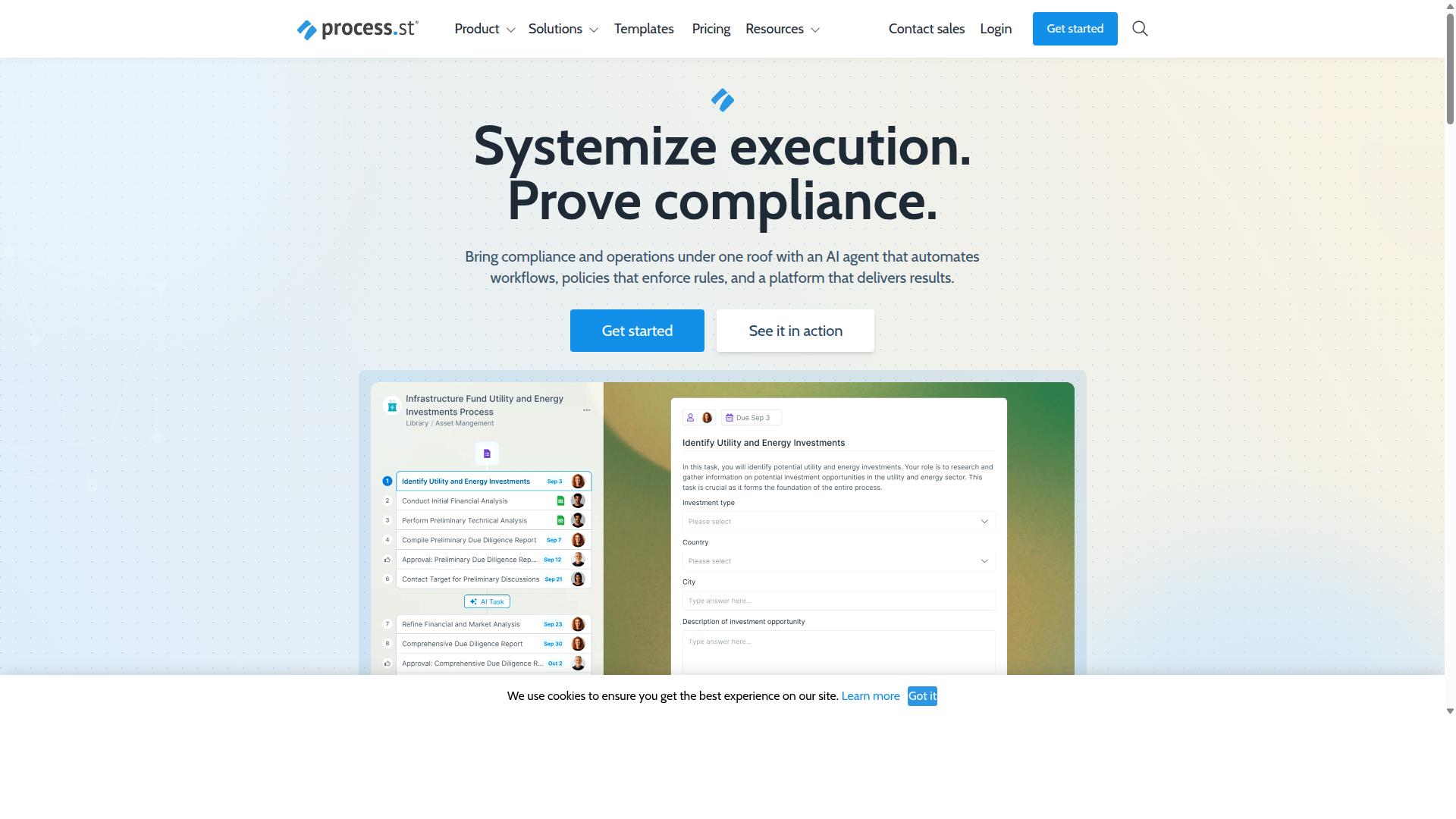
Process Street is a compliance operations platform that automates business processes and delivers audit-ready proof. The platform offers three main products that serve different operational needs.
Docs handles document management and policy control functions. Users maintain centralized records with version control and access permissions built in.
Ops powers workflow automation and process orchestration across teams. This product manages task assignments, approval processes, and conditional logic flows.
Cora functions as an AI compliance and risk agent that supports regulatory compliance and risk assessment activities. The three products work together to standardize processes and prove compliance across industries.
Why Process Street Is the Best for Custom Risk Workflows
Process Street converts static policies into AI-powered workflows that enforce specific risk controls. This approach transforms how organizations handle compliance and risk management. Workflow automation replaces manual processes with structured, repeatable systems.
Conditional logic routes tasks to the right approvers based on predefined criteria. When a risk threshold is exceeded, the system automatically assigns the task to the appropriate reviewer. This ensures that risk assessment receives attention from qualified personnel without delays or misrouting.
Approval processes create immutable audit trails that document every decision and action. Each step in the workflow is recorded with timestamps, user identities, and outcome details. These records support regulatory compliance requirements across multiple standards.
Process Street includes Docs for document management and policy control with full governance for ISO 9001, SOC 2, SOX, and FDA requirements. The Ops platform turns policies into AI-powered workflows that maintain consistency across operations. Cora, the AI compliance agent, monitors regulations and flags risks continuously.
Platform features like Process AI, Automations, Analytics, Apps, and Integrations support custom risk workflows at scale. The system integrates with Zapier, Microsoft Power Automate, Tray.io, Make, and offers Public API access for extended functionality. Process documentation becomes enforceable through these connected tools.
Role-based access controls ensure that sensitive risk data reaches only authorized personnel. Conditional logic can trigger different workflow paths depending on risk scores or compliance requirements. This customization supports diverse regulatory environments without requiring separate systems.
The combination of immutable audit trails and intelligent task routing creates accountability at every stage. Organizations maintain clear records while ensuring that risk mitigation steps receive proper review. Workflow customization adapts to specific industry needs and regulatory frameworks.
Key Features and What Makes Process Street Stand Out
Four capabilities differentiate Process Street in risk and compliance operations. These features work together to create efficient, traceable custom risk workflows that meet strict regulatory requirements.
The platform supports over 3,000 companies and 1 million users who need reliable process control. Each capability addresses specific challenges in risk identification, assessment, and mitigation.
Process Street delivers these features through a unified system that maintains data security and regulatory compliance across multiple frameworks. The combination produces consistent results for organizations managing complex operational risks.
Workflow Automation and Process Orchestration
Drag-and-drop builders turn policies into sequences that assign tasks to humans or bots automatically. Custom risk workflows become executable processes without requiring technical development teams for each implementation.
Ops automations handle task assignments based on conditional logic. This means specific risk events trigger the right responses at the right time without manual intervention.
Process Street has helped standardize onboarding for 49,000 plus employees across organizations. One customer, IMCD UK, reported a 75 percent reduction in setup time when implementing new risk procedures.
Documentation processes run 30 percent faster through automated routing and approval sequences. Teams maintain consistency while reducing the manual oversight typically required for compliance tracking.
AI-Powered Risk Monitoring
AI continuously checks every workflow step against risk thresholds and flags anomalies in real time. Cora monitors regulations and automates work while maintaining 24/7 oversight of potential risk indicators.
Dashboards display current risk scores and overdue tasks across active workflows. Users can generate exportable reports that support SOC 2 Type II and ISO 27001 compliance requirements.
Process AI identifies patterns that might indicate emerging risks before they escalate. The system creates audit trails automatically, which supports both internal reviews and external regulatory examinations.
Analytics provide visibility into process performance and risk trends over time. Organizations use these insights to refine their custom risk workflows based on actual operational data.
Document Management and Policy Control
Centralized Docs govern ISO 9001, SOC 2, SOX, and FDA policies with version control and role-based access. Each document maintains complete change logs that create audit-ready history for compliance verification.
Process Street holds SOC 2 Type II and ISO 27001 certifications. The platform is also HIPAA compliant with BAA available upon request, and it meets GDPR and CCPA requirements.
Approval workflows ensure policy updates follow proper review sequences. Role-based access controls limit document visibility to authorized personnel only.
Version tracking records who made changes and when modifications occurred. This creates the documentation trail required for regulatory audits and internal governance reviews.
Pricing and Plans
Three fixed tiers meet startup, mid-market, and enterprise risk and compliance needs. Each plan supplies the workflow automation and risk management capabilities businesses require to build custom risk workflows without unnecessary complexity.
The Startup plan targets smaller teams that need essential functionality. This tier includes 5 users, 10 guests, and up to 5,000 Data Set records. Users get 10 automation apps and 100 automation actions per month, plus Public API access limited to 50 calls monthly.
The Pro plan expands capacity for growing organizations. This tier removes user and guest limits while doubling Data Set records to 10,000. Custom automation actions and API calls scale with team requirements for more sophisticated risk assessment and compliance procedures.
The Enterprise plan serves organizations with complex regulatory compliance demands. Custom Data Set records accommodate extensive risk monitoring needs. Unlimited Public API access, dedicated Success Manager support, and fully-managed workflows enable comprehensive process standardization across large teams.
Enterprise customers also receive priority support, custom integrations, bulk document import capabilities, process consulting, health audits, and personalized team training. These resources help organizations maintain audit trails while scaling their risk controls and workflow customization.
Trust Signals
SOC 2 Type II and ISO 27001 certifications plus 3,000+ corporate users underpin credibility. These independent audits confirm that data handling meets rigorous security standards. Organizations can trust the platform with sensitive risk information.
Process Street serves over 3,000 companies and 1 million users worldwide. This scale demonstrates proven reliability across industries that demand strong compliance controls. The platform maintains consistent uptime and rapid support with an average 5-minute response time.
Customer testimonials highlight the value for regulated environments. One Salesforce user notes that the platform delivers clear audit trails and role-based access that simplify risk management. These endorsements reflect real-world success with custom risk workflows.
Additional compliance features include HIPAA readiness with a BAA available upon request, GDPR, CCPA, and AWS CIS alignment. The platform never uses customer data for AI training, which protects proprietary risk information. These safeguards create a trustworthy foundation for workflow automation in high-stakes environments.
Who Should Use Process Street
Operations, compliance, HR, finance, and IT teams in financial services, healthcare, manufacturing, and tech adopt Process Street. These groups use the platform to build custom risk workflows that match their specific industry requirements and regulatory obligations.
Operations teams handle daily process oversight and risk monitoring. A manufacturing operations manager can create quality tracking workflows that flag production issues before they escalate into larger problems.
Compliance teams manage regulatory requirements across multiple frameworks. A healthcare compliance officer can set up ISO compliance workflows that maintain audit trails and document control throughout the organization.
Finance teams focus on financial controls and reporting accuracy. A financial services compliance specialist can develop SOX testing workflows that track approvals and maintain evidence for regulatory examinations.
HR departments manage employee-related risks and documentation needs. A technology company HR manager can establish employee onboarding workflows that include risk assessment steps at each stage of the hiring process.
IT and security teams protect systems and data assets. A capital markets IT security lead can build custom workflows that include conditional logic for access reviews and risk mitigation procedures.
Customer management teams reduce client-related operational risks. A professional services firm can create client onboarding workflows that standardize risk identification and approval processes across different account types.
Real estate and property management teams address compliance and safety risks. A property management company can develop document control workflows that track lease agreements and maintenance schedules through automated task assignments.
Final Verdict
Process Street combines workflow automation, document governance, and audit trails in a single SOC 2 Type II platform. This integrated approach addresses the core requirements of custom risk workflows without forcing teams to manage multiple disconnected tools.
Organizations see measurable returns through faster execution. Teams achieve 30 percent faster documentation and 75 percent faster setup when moving from manual processes to structured Process Street workflows. These gains compound across risk assessment, compliance documentation, and approval processes.
Contact sales via email, chat, or AWS Marketplace to evaluate fit for your specific requirements. Response times average five minutes with a 98 percent customer rating, allowing teams to move from inquiry to implementation quickly.
Recommended Resources: