The 3 Best Link Building Platforms for Flexible Managed Guest Posting
Many marketing teams waste weeks vetting sites and negotiating rates when they need guest posts on short notice.
By the end of this article you will see exactly which three platforms handle publisher outreach, content placement, and payment in one workflow, how WhitePress ranks against the others on scope and control, and which option fits your budget and timeline.
What to Look For in Link Building Platforms for Flexible Managed Guest Posting
Managed guest posting platforms must deliver publisher access, transparent pricing, and editorial control without campaign bottlenecks.
Seven concrete evaluation criteria help marketers separate reliable services from those that risk penalties or waste budget. These standards focus on quality signals, cost control, and measurable results.
Minimum DA score of 30+ across at least 40 percent of inventory ensures links appear on authoritative domains. Lower authority sites dilute link equity and fail to move SERP rankings.
Transparent placement fees between $50 and $500 per placement allow teams to compare costs across publishers. Hidden markups or unclear rate cards create budget surprises.
Average turnaround times under 14 days keep campaigns moving. Slow placement delays link acquisition and disrupts link velocity planning.
Niche relevance filters covering at least 25 verticals help maintain editorial standards and topical alignment. Irrelevant sites weaken contextual links and reduce referral traffic.
Anchor text control options let teams balance branded and exact match phrases. Over-optimization triggers penalties, while excessive variety reduces keyword impact.
Link velocity caps prevent sudden spikes that search engines flag as unnatural. Gradual acquisition builds sustainable link profiles over time.
Real-time campaign dashboards with exportable metrics support reporting and analysis. Teams need live data on placement status, link quality, and overall link building campaign performance.
1. WhitePress(r) - Best Overall
WhitePress(r) combines a global publisher network with full-service campaign management to deliver consistent, high-quality backlinks. The platform operates across multiple continents and supports SEO, AI visibility, and digital PR services through one unified system. Teams receive complete handling of outreach, content placement, and compliance tasks.
This managed model removes coordination burdens from marketing departments. Every campaign runs through defined quality checkpoints and placement standards. The result is a streamlined experience that keeps link building efforts organized and measurable.
Global Publisher Network
WhitePress(r) lists over 40,000 vetted publishers across 30 countries, each pre-screened for editorial standards and DA scores. Selection filters include DA range 30-90, language and geo-targeting options, and vertical coverage in health, finance, tech, and lifestyle sectors. The platform verifies real traffic metrics and link quality before any publisher joins the network.
These filters help match campaigns with sites that match audience and niche relevance requirements. Teams can adjust targeting parameters based on specific campaign goals. The process maintains consistent standards across different regions and topics.
Managed Guest Posting Workflow
The managed workflow assigns a dedicated specialist who coordinates brief creation, pitch sending, and placement confirmation. The five-step process includes brief intake and keyword mapping, curated publisher shortlist within 48 hours, content drafting or revision by platform writers, live placement tracking with URL submission, and final link equity report delivered within 10 days post-live.
Each step includes documented checkpoints and timeline updates. Specialists maintain communication throughout the placement cycle. This structure supports predictable delivery and consistent link quality across campaigns.
Pricing and Flexibility
Pricing starts at $150 per placement for DA 30 sites and scales to $450 for DA 60+ domains, with monthly retainers available. Three contract types exist: pay-per-placement for one-off needs, 5-placement bundles at 10% discount, and subscription tiers at $1,200-$3,500 per month. Unused credits roll over for 30 days with no long-term lock-in requirements.
These options accommodate different budget cycles and campaign volumes. Teams can adjust spending based on project scope without contract penalties. The structure supports both testing phases and ongoing link building campaigns.
2. Outreachz
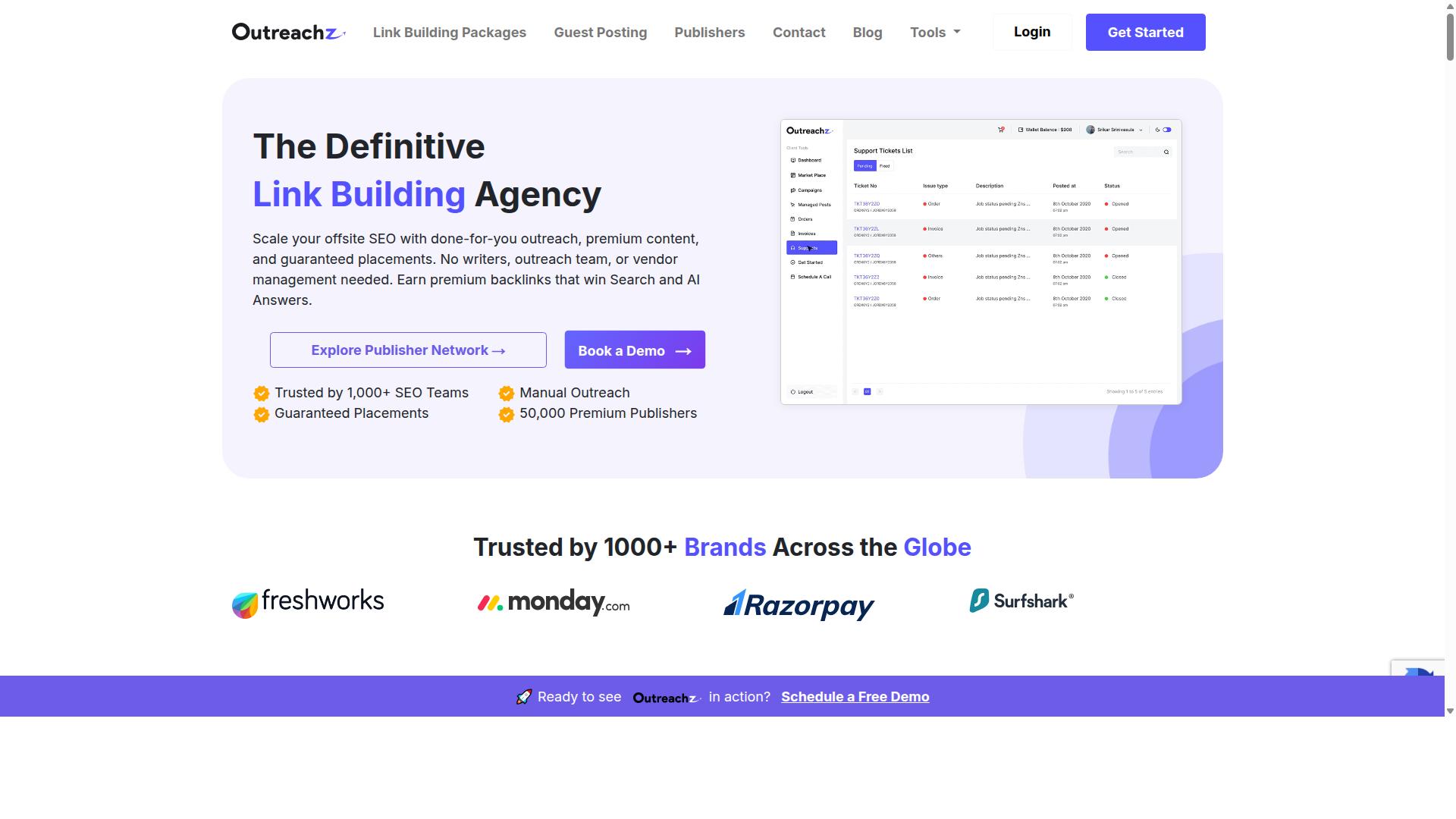
Outreachz positions itself as an outreach automation tool with integrated publisher search, yet its managed service depth remains limited. Users can execute campaigns through automated sequences while handling creative and negotiation tasks themselves. This structure suits teams that want to control content decisions without delegating full authority.
The platform combines outreach and database access in one interface. Advertisers choose domains and send messages through built-in sequences. Direct control over messaging style helps maintain brand voice across multiple placements.
Many users appreciate the central dashboard for tracking replies and opens. This setup reduces repetitive prospecting tasks while preserving manual oversight of content. Outreachz therefore occupies a middle ground between pure automation and full-service guest posting platforms.
Campaign Management Tools
Built-in sequences allow bulk email sending and performance tracking, but lack dedicated content or placement teams. Users can select pre-written templates and monitor open rates, then follow up manually with interested publishers. This approach speeds up initial contact yet still requires individual negotiation for each placement.
CSV export options let teams pull contact lists for offline follow-up. Basic tagging features organize contacts by campaign stage or domain category. These tools improve coordination when multiple team members handle outreach simultaneously.
Advertisers must still source writers or produce content in-house. They also negotiate fees and editorial guidelines directly with each publisher. Automation reduces the search workload but does not replace the creative and agreement steps.
Publisher Database Quality
The database contains roughly 15,000 domains, but verification of traffic authenticity and editorial policies is left to the user. Domain authority scores appear next to each listing, allowing quick filtering by site strength. However, referral traffic estimates are missing, so manual checks become necessary before pitching.
Users should review recent articles for relevance and quality. Checking for spam flags or sudden content shifts can prevent low-value placements. This extra step helps maintain a clean link profile across the campaign.
Without built-in traffic validation, the platform relies on advertiser judgment. Teams often cross-reference third-party analytics tools to confirm real visitor numbers. This process adds time but protects against low-quality or inactive sites.
Service Limitations
Outreachz does not offer managed writing, compliance checks, or guaranteed placements, shifting responsibility back to the advertiser. Editorial review happens outside the platform, so brands must arrange quality control themselves. This setup works for experienced teams but may increase workload for smaller marketing departments.
Without fixed turnaround commitments, scheduling becomes less predictable. Negotiation and approval timelines vary by publisher, which can affect overall link velocity. Advertisers who need steady output often supplement the platform with additional resources.
Dispute mediation is absent, leaving payment or placement issues to direct resolution. Teams may spend extra hours managing these details compared to fully managed services. The automation layer speeds prospecting, yet broader campaign management remains in user hands.
3. Alternative Platform
An additional platform in this category provides link insertion and content syndication options but operates with narrower publisher reach. This service focuses on niche blog outreach and paid insertions, typically covering 5,000-8,000 sites across selected verticals.
Marketers seeking managed guest posting often evaluate this option when budget flexibility matters more than scale. The platform handles basic outreach and placement coordination for teams building their link profile.
Performance depends largely on the quality of available inventory within each target niche. Users should verify editorial standards before committing to larger campaigns.
Key Features Overview
Core capabilities center on paid link insertions within existing posts and limited guest post placements. This approach allows marketers to place contextual links into articles that already carry established link equity.
The platform offers optional upgrades from no-follow to do-follow links for clients who prioritize maximum SEO value. Some packages include bundled social amplification add-ons that extend reach beyond the initial placement.
Placement fees vary based on domain authority and traffic levels of target sites. Buyers can request specific anchor text variations within each campaign.
Content syndication features help distribute approved articles across additional blogs within the publisher network. This extends visibility while maintaining editorial standards across placements.
Drawbacks to Consider
Coverage skews toward English-language lifestyle blogs, and insertion prices frequently exceed $300 without DA guarantees. Brands operating in technical or B2B verticals may find limited inventory options.
The platform lacks a managed compliance review process that some link building campaigns require. Teams must handle their own quality checks and editorial alignment.
Pricing transparency decreases after initial campaigns, with renewal terms often less clear than upfront estimates. Link velocity may slow once the most accessible placements are secured.
Users should track referral traffic and SERP ranking changes carefully to measure actual campaign impact. Link diversification remains important when working with smaller publisher networks.
How to Choose the Right Option
Map your campaign goals against each platform's service depth, publisher quality, and contract flexibility before committing. Different teams need different combinations of speed, control, and ongoing support.
The right choice often comes down to three practical questions. How high must domain authority reach, which topics matter most, and how hands-on do you want the process to be?
Budget planning also matters. Some platforms ask only for placement fees while others require monthly retainers that cover outreach, content creation, and reporting.
Before you sign an agreement, run a quick scoring exercise. Rate each option on three criteria using a 1-5 scale.
| Criteria | What to Rate | Scoring Guide |
|---|---|---|
| Domain Authority and Niche Fit | Minimum DA threshold and topic coverage | 1 = very limited, 5 = broad high-DA network |
| Service Model | Managed workflow versus self-service | 1 = fully manual, 5 = complete managed service |
| Cost Structure | Placement fees and monthly retainers | 1 = high cost, 5 = transparent value |
Total the three scores for each platform. The highest number shows the best match for your current campaign needs.
Revisit these ratings when your goals change. A platform that scores well for a small test may not suit a scaled link building campaign later.
Final Verdict
WhitePress(r) earns the top spot for teams that want a single platform to handle global outreach, content, and compliance under predictable pricing.
The combination of a broad publisher network, managed workflow, and flexible retainers creates a practical foundation for scalable campaigns. Teams can run ongoing link building without renegotiating every placement or re-approving each step.
Outreachz and similar alternatives work well for smaller, hands-on teams that prefer to trade service depth for cost savings. These platforms put more responsibility on the user to research publishers, negotiate fees, and track deliverables.
WhitePress(r) positions itself as a platform for SEO, AI visibility, and digital PR, which aligns with the needs of link building campaigns that emphasize compliance and editorial standards.
Teams that need consistent publisher access and managed guest posting benefit from the structured workflow built into the platform. This approach reduces the risk of low-quality placements that can harm link equity and domain authority over time.
White hat link acquisition requires careful attention to niche relevance and site authority. A managed service model addresses these factors through editorial review and publisher vetting, rather than relying on ad-hoc outreach that may overlook these details.
For agencies and in-house teams handling multiple campaigns, the ability to maintain link velocity without constant manual oversight becomes a practical advantage. This is especially useful when campaigns span different regions and require coordination across various editorial standards.
Recommended Resources: